ZURICH SIISSOP 2040
Armand Etoundi
Published
Zürich 2040 — AI/ML-Enhanced SIISSOP
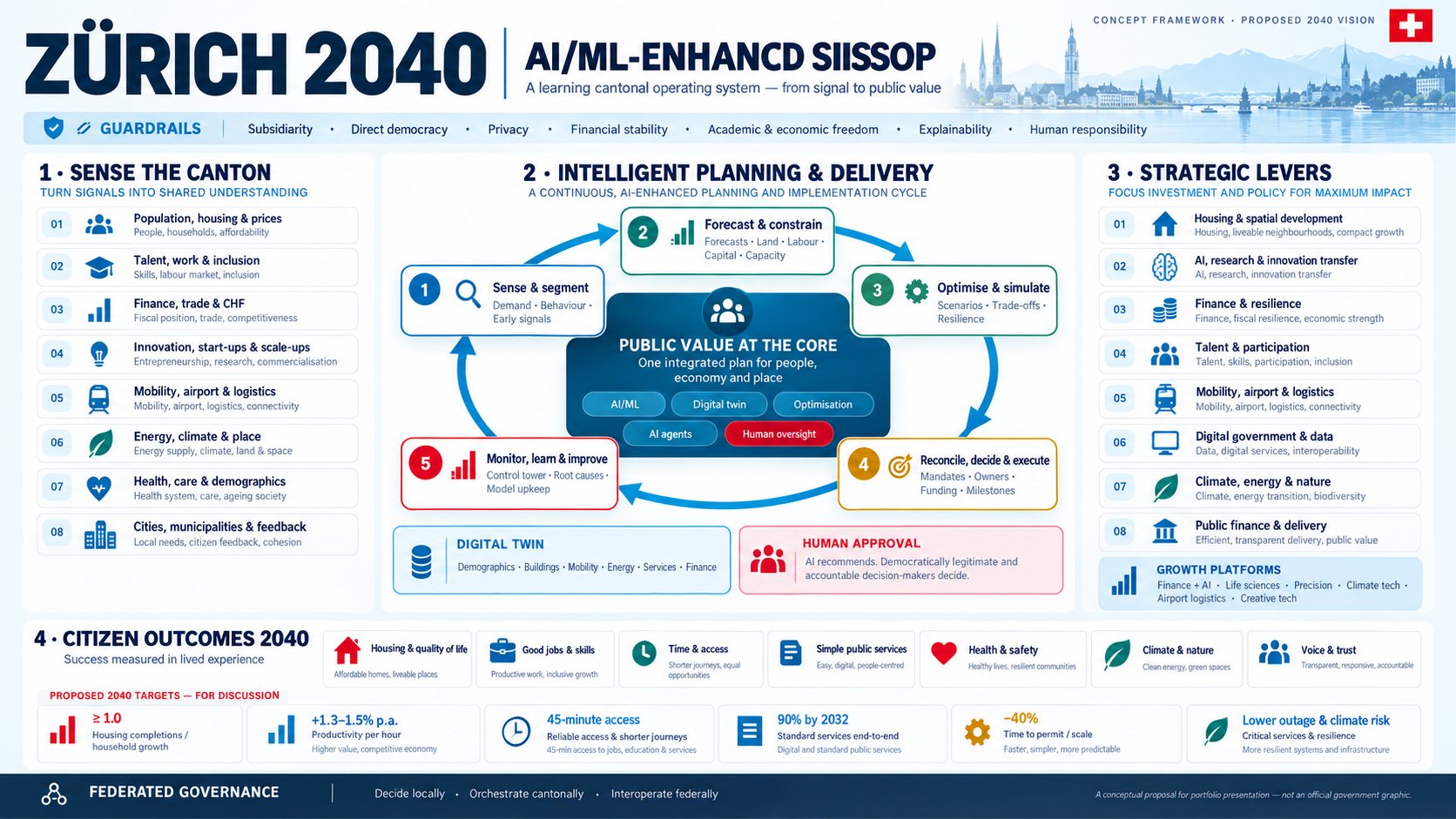
Zürich 2040 presents a conceptual framework for a learning cantonal operating system that connects public needs, strategic planning and coordinated delivery. It explores how artificial intelligence, machine learning and digital twins could support better decisions while keeping public value and human accountability at the centre.
The model begins with signals from eight interconnected areas: population and housing; talent and participation; finance and trade; innovation; mobility and logistics; energy and climate; health and demographics; and municipal feedback. These inputs inform a continuous cycle of sensing, forecasting, simulation, decision-making, implementation and learning.
A proposed cantonal digital twin brings these perspectives together to examine scenarios, constraints and trade-offs. AI supports analysis and recommendations, while democratically legitimate and accountable decision-makers retain responsibility for approval and action. The framework establishes guardrails around subsidiarity, direct democracy, privacy, financial stability, academic and economic freedom, explainability and human responsibility.
Eight strategic levers connect planning to delivery, spanning housing, research, financial resilience, skills, transport, digital government, climate and public finances. Their intended impact is expressed through seven citizen outcomes: better housing and quality of life, good jobs and skills, reliable access, simpler public services, health and safety, environmental quality, and stronger participation and trust.
Proposed 2040 targets provide a direction for evaluation across housing supply, productivity, accessibility, service digitisation, approval times and infrastructure resilience. These are presented as ambitions for discussion rather than achieved results.
The bilingual infographic translates a complex governance concept into a structured visual narrative. Its central planning loop, colour-coded strategic levers and citizen outcome panels show how information could move from local signals to measurable public benefit. The project offers a vision of coordinated, adaptive government focused on the lived experience of Zürich’s residents.