RJ van Beek
Most freelance designers do not lose money because they are bad at design. They lose it in the blur around the design process.
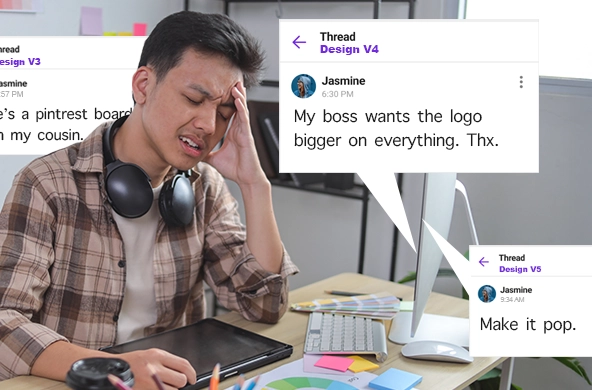
As someone who has worked with clients as both a freelancer and in agencies for close to 20 years, I’ve seen it happen hundreds of times. A “quick chat” turns into a free strategy session. A proposal takes two hours to write and never gets a reply. Then your client slowly reveals they also need social templates, a mini brand guide, Canva files, launch graphics, and “maybe just a few ideas for the website while we’re at it.”
Over time, these client interactions eat into your margins, your schedule, and your ability to predict what next month will look like.
They also eat into your sanity and make you question you design abilities.
That is where productized services can help.
Instead of treating every project like a blank page, you turn the work you already do well into a clear, fixed offer that clients can understand, buy, and start without weeks of soul-sucking back-and-forth.
In this guide we’ll show you just how it works and how to build your first Productised Offer.
💡 TL;DR
Productization means turning a repeatable freelance service into a clear, fixed offer with a defined outcome, scope, price, timeline, and intake process.
For freelance designers, this solves a common problem: too much time gets lost in unpaid calls, custom proposals, vague briefs, unclear deliverables, and scope creep. Instead of starting every project from scratch, you package the work you already do well so clients know exactly what they are buying and you know exactly what you are delivering.
In this guide, you’ll learn how to:
- Identify the services you already repeat across client projects.
- Turn those services into clear packages built around client outcomes.
- Define what is included, what is not included, and where add-ons fit.
- Use powerful tools like Paperform to create a smoother client intake process that collects the brief, files, payment, and next steps in one place.
- Turn a static portfolio into a simple Service Storefront.
- Test one package first, improve it, and build a more predictable freelance business over time.
The problem: you’re selling repeat work like it’s brand new
There is nothing wrong with custom work. As designers, we take pride in it! Creating something new and fresh feels good. And yes, some projects need a custom proposal, especially if a client wants a full identity system, packaging, website, campaign direction, and ongoing creative support.
The problem is when every enquiry gets treated like a one-off, even when the work is familiar.
Yes, every client is unique and their briefs might sound like different projects, but there is usually a repeatable shape underneath them: same type of client, same core problem, same questions, same deliverables, same risk of scope creep.
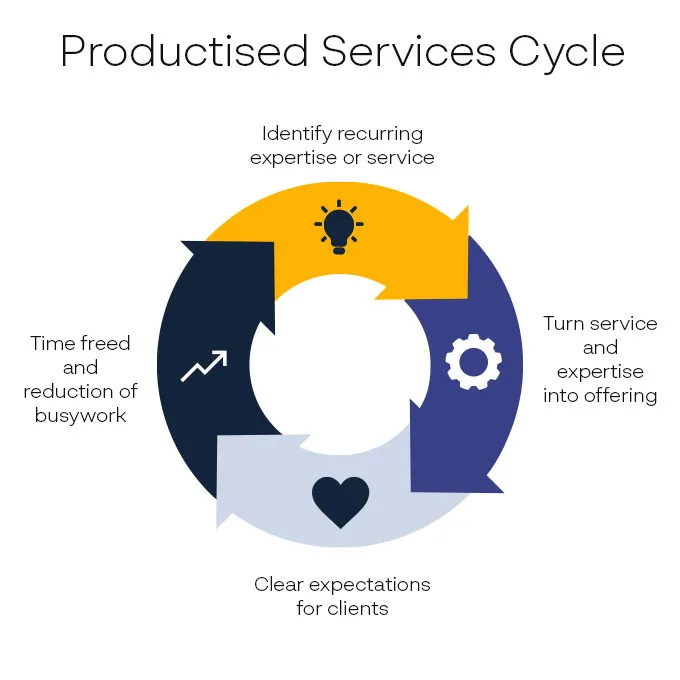
When that repeatable work is not packaged, you pay for it over and over again in unpaid calls, proposal writing, vague pricing conversations, and client expectations that were never properly defined.
The issue is usually client ignorance
The issue is rarely that clients are trying to take advantage of you. Honestly, I’ve learned that most clients just do not know how design projects work. They may not know the difference between a logo and a brand system, a homepage mockup and a full website, or a set of social templates and a complete content strategy.
If you do not define the shape of the service, they will guess. And their guess will usually be bigger than yours.
Productized services solve this by making the offer clear before the client buys. The result, scope, price, timeline, intake process, and next steps are all visible upfront. That does not make your work less creative. It makes the business side less chaotic.
So, where do you start?
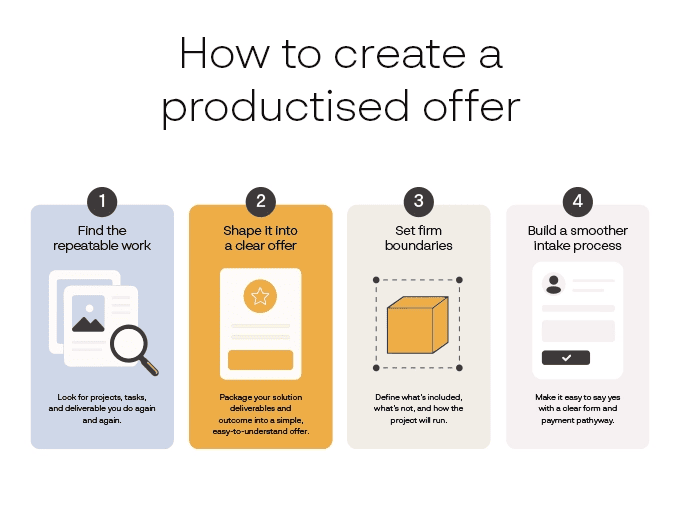
The fix is not just naming a package and putting a price on it. You need to make the whole service easier to understand, buy, start, and deliver. That means finding the repeatable work, shaping it into a clear offer, setting firm boundaries, and building a smoother intake process so clients know what they are getting before the project begins.
So here is our step-by-step guide.
Step 1: Find the service you already repeat
Do not start by inventing a completely new offer. Start by looking at what people already pay you to do.
Review your last 10 to 20 projects and look for patterns. Not just the prettiest portfolio pieces, but the jobs that were profitable, easy to explain, and smooth to run.
Ask yourself:
- What do clients keep coming to me for?
- What problem do I keep solving in slightly different ways?
- What deliverables do I keep rebuilding?
- Which projects had a clear before and after?
- Which projects were easy for clients to understand?
- Which ones would I happily sell again at the same price?
- Which projects could start with a strong intake form instead of another meeting?
Here is how that might look in practice:
If clients keep asking for… | The real problem might be… | Productized service idea |
|---|---|---|
“Just a simple logo” | They need to look credible before launch | Launch-Ready Brand Kit |
“Can you clean up our visuals?” | Their brand is inconsistent across channels | Brand Cleanup Sprint |
“We need some social posts” | They need a reusable content design system | Social Template Pack |
“Can you make this deck look better?” | Their pitch looks less professional than the idea | Pitch Deck Polish |
“We’re launching soon and need assets” | They need a focused set of launch visuals | Launch Creative Kit |
The trick is to package the client’s outcome, not your discipline.
Most clients are not thinking, “I need a comprehensive visual identity solution.” They are thinking, “My brand looks cheap,” “my deck is embarrassing,” or “my launch is in three weeks and nothing looks ready.”
Start there.
Step 2: Turn the outcome into a clear offer
Once you have found a repeatable service, shape it around the result the client wants.
A productized service should not feel like a random bundle of deliverables. It should feel like a clear path from the client’s current problem to the result they need.
For example:
Client situation | Stronger packaged outcome |
|---|---|
“I’m launching soon and need to look credible.” | A polished starter identity with the core assets needed for launch. |
“My brand feels messy and inconsistent.” | A cleaned-up visual system with clearer rules and reusable assets. |
“My pitch deck looks homemade.” | A more professional deck that feels credible to investors, partners, or clients. |
“My social posts are all over the place.” | A reusable set of branded templates the client can keep using. |
Once the outcome is clear, choose the deliverables that directly support it. Not every possible thing you could do. Just what the client needs to get the promised result.
A simple package structure might look like this:
Package name | Launch-Ready Brand Kit |
Who it is for? | Founders preparing to launch who need to look credible, but are not ready for a full brand identity project. |
Outcome | A clean starter identity with the core visuals needed for a website, socials, and launch materials. |
Included | Logo refinement, color palette, font pairing, mini brand guide, social profile graphics, three launch post templates. |
Timeline | Delivered within 10 business days after the intake form is complete and all assets are received. |
Price | $2,500 fixed fee, with a 50% deposit required to book. |
At this point, the service should be easy to explain in one sentence:
“I help early-stage founders get a polished starter brand in 10 business days for a fixed price.”
That is much stronger than “I do branding.”
Step 3: Set boundaries before the client buys
A fixed-price service without boundaries is just unlimited design with a nicer name.
This is where a lot of productized services fall apart. The freelancer adds a neat package to their website, but the scope is still soft. So the same old problems come back: extra versions, extra formats, extra pages, extra templates, extra “quick” ideas.
Good boundaries do not need to sound cold, they just need to be visible before the client pays.
For each package, define:
- Deliverables
- Timeline
- Number of concepts
- Number of revision rounds
- File formats
- Client inputs required
- What is excluded
- Available add-ons
Here is an example for a Social Template Pack:
- 10 custom Canva templates
- Three post styles
- Three story styles
- Two carousel layouts
- Two promotional layouts
- One visual direction
- One revision round
- Delivery within seven business days after brief and assets are received
And here is what you might exclude:
- Copywriting
- Posting or scheduling
- Logo design
- Brand strategy
- Custom illustration
- Extra template sizes
- Additional revision rounds
- Ongoing content planning
Exclusions are not there to make you sound difficult. They are there to stop the client from assuming the package includes everything adjacent to the thing they bought.
If you sell a logo refresh, say whether it includes a full brand guide. If you sell a pitch deck polish, say whether it includes copywriting. If you sell social templates, say whether it includes captions. If you sell a homepage visual refresh, say whether it includes development.
Clear boundaries also make you easier to work with. When a client asks for something outside the package, you do not have to over-explain. You can say, “That is outside this package, but I can add it on,” or “That would be better as a custom project.”
That is not less personal. It is less confusing.
Step 4: Productize the way clients start the project
Packaging the service is only half the job. You also need to package the way people buy it.
This is where a lot of designers get stuck. They create a fixed package, add it to their site, and then still send every client through the same scattered process: email, calendar link, proposal, invoice, shared folder, missing attachments, follow-up reminders, and a half-complete brief.
The offer is fixed, but the admin is still custom.
A better approach is to create a simple Service Storefront: a page or flow where a client can choose the package, understand the scope, submit the right details, upload files, and pay a deposit or full fee upfront.
Think of it this way:
A portfolio:
- Shows what you can do
- Displays past work
- Usually ends with “get in touch”
- Creates interest
A Service Storefront:
- Helps the client start
- Collects project details
- Guides the client through the next step
- Creates momentum
Using tools like Paperform, you can build this as a branded experience rather than a generic contact form or clunky checkout page. You can present the package, explain who it is for, list what is included, show the price, ask the right intake questions, collect files, and take payment in the same place.
This matters because design projects rarely fall apart at the payment button. They get messy in the handoff.
The deadline is mentioned in an email but not captured anywhere useful. The client sends the wrong logo file. The brief is answered by someone who is not actually approving the work. The scope lives in a proposal, the assets live in Dropbox, and the real expectations live in someone’s head.
A good intake flow brings the start of the project into one place.
For example:
Package | Useful intake questions |
|---|---|
Brand Cleanup Sprint | Current logo, website, social links, existing brand assets, examples they like, examples they hate, what currently feels “off.” |
Pitch Deck Polish | Current deck, deadline, brand files, target audience, presentation context, slides that cannot change. |
Social Template Pack | Platforms, post types, brand colors, Canva access, preferred dimensions, content examples, recurring content formats. |
Launch-Ready Brand Kit | Business name, audience, competitors, launch date, current assets, visual references, colors to avoid, desired brand impression. |
You can also make the experience smarter without making it longer. If someone chooses “Pitch Deck Polish,” they should not see questions about Instagram templates. If they choose “Brand Cleanup Sprint,” they should not be asked to upload a slide deck.
Using conditional logic in a tool like Paperform, the client only sees what is relevant, and you only receive what you need. That is the difference between a contact form and a proper intake experience.
One asks, “What do you need?”
The other guides the client into a project that is already well-defined.
Step 5: Build the first version, not the perfect version
You do not need six productized services on day one. Start with one.
Choose the offer that is easiest to explain, easiest to scope, and most clearly tied to a client pain point. Put it on your site, share it with past clients, mention it in sales conversations, and see what happens.
A good first version can be simple:
Element | First version |
|---|---|
Offer | One clear package |
Pricing | One fixed price or deposit |
Scope | Clear inclusions and exclusions |
Intake | One guided form |
Assets | File upload fields for what you need |
Payment | Deposit or full payment |
Follow-up | Confirmation message with next steps |
Using tools like Paperform, you can turn this into a clean buying and briefing flow without building a full e-commerce site. Your form might include a short intro, package details, a checklist of what is included, a few exclusions, file uploads, payment, and a confirmation message.
Keep the first version small enough to learn from. Then pay attention to what happens.
If everyone asks whether copywriting is included, your scope needs to be clearer. If people like the offer but hesitate at the price, you may need to explain the value better. If clients keep asking for the same extra deliverable, that might become an add-on. If every project still feels custom, the package is probably too broad.
A productized service is not set in stone. Treat it like a designed object: launch the first version, watch how people use it, then refine it.
Over time, you can build a small menu of offers:
Client need | Offer type |
|---|---|
“I need direction before I commit.” | Paid audit or creative review |
“I need one specific result.” | Fixed package |
“I need deeper support.” | Custom project |
“I need ongoing help.” | Retainer or monthly creative support |
This gives buyers a clearer path and gives you a better way to qualify leads. Not every enquiry needs to become a blank-page proposal.
What to include in your first Service Storefront
Your first Service Storefront does not need to be complicated. You are not building a giant shop with ten offers, upsells, and a 40-question brief. You are creating a cleaner way for the right client to start the right project.
A strong first version might include:
Section | Purpose |
|---|---|
Short intro | Explain who the package is for and what problem it solves. |
Package details | Show the outcome, price, timeline, and what is included. |
Exclusions | Prevent assumptions before they turn into scope creep. |
Package selector | Let clients choose between versions or add-ons. |
Intake questions | Collect the brief details you need to do the work well. |
File uploads | Gather logos, screenshots, brand assets, references, or decks. |
Payment | Collect a deposit or full payment before work begins. |
Confirmation message | Tell the client what happens next and when they will hear from you. |
For designers, the intake experience is part of the client experience. If the first thing a client sees after deciding to work with you is a cold, generic form, the service can feel less considered.
Using tools like Paperform, you can make the page feel like an extension of your brand: polished, visual, clear, and easy to move through. Templates like these are a good place to start.
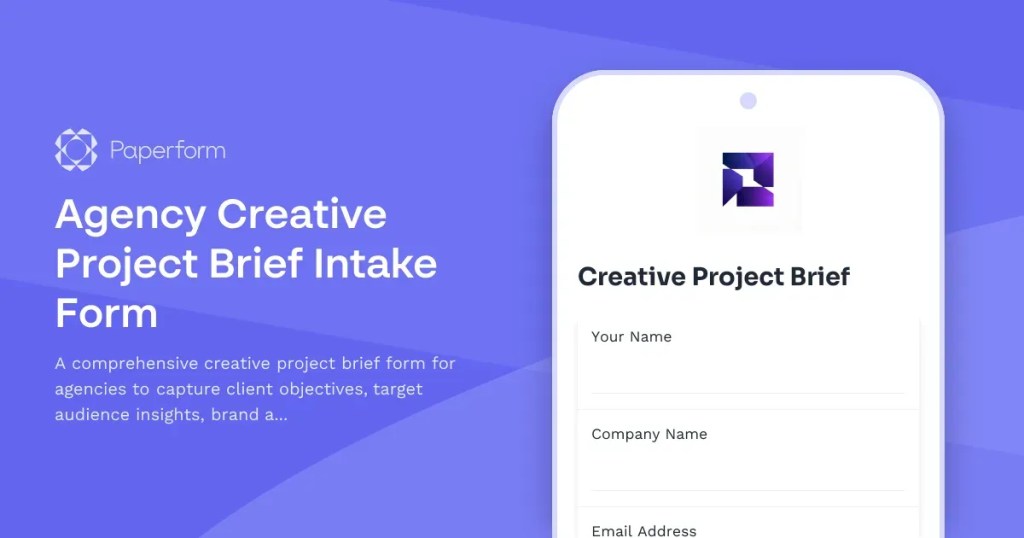
A strong intake form gives clients confidence before the project even begins. It also gives you better information before the work starts, which means fewer scattered emails, fewer missing files, fewer awkward payment reminders, and fewer projects that begin with “I thought this came with…”
Productized does not mean boring
Some designers hear “productized service” and picture bland templates, rigid processes, and work that all looks the same. That is not the goal.
The goal is not to flatten your taste or make every project identical. It is to stop rebuilding the business side of the work every time someone wants to hire you.
You still bring the eye. You still make the creative calls. You still notice what the client cannot articulate. You are simply giving that work a better container.
A clear offer helps clients trust you faster. A fixed scope protects your margin. A strong intake process gets you the details you need before the clock starts. Upfront payment changes the tone of the project from “maybe we’ll work together” to “we’re ready to begin.”
That is the value of productizing your design services. It makes the offer clearer, the buying experience smoother, and the project easier to start well.
Your work still feels personal. Your process feels professional. And for a client who is ready to move, that clarity can be the reason they choose you.


 Twine
Twine
 Raksha